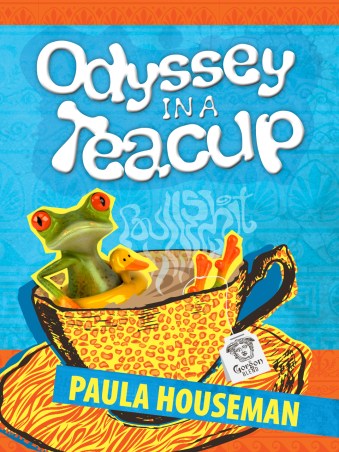
Houseman, Paula (2015). Odyssey in a Teacup. Sydney, Australia: Wildwoman Publishing
Review by: Stephanie L. Harper
Paula Houseman’s Odyssey in a Teacup (purchase on Amazon) takes readers along with protagonist, Ruth Roth, on a brilliantly crafted, classic hero’s journey. From her initial stirrings, awakenings, and blaring Call to Adventure, through her protracted Initiation of descents and dashings upon the rocks (during which phase Ruth’s internal “bullshit detector” becomes a well-oiled, exquisitely adept machine), to her ultimate, victorious Return to the Self, Ruth encounters and defeats a series of soul-sucking harpies, who time and again try to bite off more than they can chew.
The decided “black sheep” of her family, the ruthlessly undermining treatment Ruth endures as a child is almost too terrible to see… Almost. If it were not for Houseman’s brazen wit, keen understanding of the ancient, universal forces at work in the very roots of humanity, and magnificently bawdy humor, Ruth Roth’s Odyssey would be little more than a lonely trek. Instead, in the very first chapter, when Ruth triumphs in an embarrassing modern-day encounter with “Cyclops,” we rush to back our champion with an unprecedented resolve — never leaving her side for the duration — and we are rewarded over and over with wretchedly wonderful, belly-shaking laughter, and liberating tears.
Houseman resurrects from the darkness (of fundamental, moralistic terrorism) the human soul, which we learn as children to regard as too grotesque as to be worthy of sight. In relating one such example of our conditioned belief in the shamefulness of our own humanity, she astutely observes the collective sentiment, “A cloud passed in front of the sun as if to stop it from seeing. Even nature was mortified.” But as the story progresses, such sentiments prove to be nothing more than our fearful, self-defeating human projections onto Nature, and Houseman’s heroine shines brightly — with moxie, and with the categorical approval of the gods and goddesses — in the sun.
Paula Houseman possesses all the verve, aplomb, and wisdom lauded of veteran authors. With rare authenticity and vigor, Houseman reveals the formative events of Ruth Roth’s life in a series of vignettes that infuse the pandemonium of Jackson Pollock expressionism with the clarity of purpose of the Sistine Chapel ceiling. We sense in each instance that Ruth ought to be asking herself, incredulously, How can this be my life? How can Nature permit another day of this existence to unfold? We feel we ought to avert our eyes, but we are captivated by a truth which strikes so close to home for us, because it so aptly mirrors that most basic of human truths: we are not born knowing how to recognize, much less question, the aberrations of dysfunctional family life, as they comprise our normal experience.
Yet, despite the mythical monsters’ best efforts to thwart her, Ruth Roth prevails as our champion. She becomes our mouthpiece, articulating for us the question that has always been lurking there, beneath the living room’s imitation woodgrain wallpaper, by exposing the fantastic lie that has surreptitiously enlisted our complicity in maintaining others’ fragile illusions at the expense of our realities.
Houseman’s Odyssey in a Teacup is epically defiant, bold, painful, hilarious, soul-fortifying, and a must-read for anyone who has ever dared (or hoped) to look at themselves in the mirror and ask the question, How in the hell have I survived?



 SLHARPERPOETRY