Despair

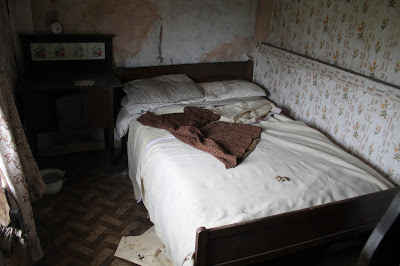
bedroomdespair

They creep along the crease where plaster’s link
with geometric     terra cotta inlays
slips beyond the statutory pane’s oblique
illumination         Squalor’s dreg-lined byways

evince these shadows’ huddled histories
of furtive ventures through the crevices
where nights yield to darkening that sullies
the dark     & dank     spore-stippled surfaces

despair the light of noon to bare their scourge
No teakwood bed     nor wicker chair     will mask
depravity     as Geishas deftly forge
refinements to obscure the blights of dusk

What’s bent by vice yet breaks for dearth of rest
& makes its bed with vermin as needs must

STEPHANIE L. HARPER

Wise at Thirty-Five, Revised at Forty

out-out-brief-candle

          “Out, out, brief candle!
Life’s but a walking shadow, a poor player
That struts and frets his hour upon the stage,
And then is heard no more.”             William Shakespeare

Yes, those two, distinct ages of mine
pulled off quite the elaborate spectacle—
circling one another in yin-and-yang-fashion,
gurgling toward a neurotic crescendo,
then sputtering into oblivion.

In relishing the living left to do,
I relive the living that can’t be
redone—today’s waterfall of yesterdays
spills over into the uncertain basin
of tomorrow.

I once believed I was unmovable,
a boulder’s crest in a rushing stream—
but soaked as I am to the bone in cold humility,
I now glisten my own, trembling shadows.

“Tomorrow and tomorrow and tomorrow”—
the tomorrows do keep their “petty pace”—
and regardless of how we spend, squander,
mete out, or justify them,
we eventually forget their order,
and lose track of which ones were real,
and which were dreaming,
or whether any one’s disappearance over the cliff’s edge
is quantifiably different from any other’s.

I have tried and failed to live up to
the tomorrows’ skulking expectations
performing the scenes from a moral composition,
which I now get that I had scripted for myself:
I’ve faced pink-nosed and dreamy-eyed
into an icy, winter wind—to look exotic,
like the cover illustration for Eloise in Moscow,
and I’ve lapped naked at the river banks
beneath a sun-streaked summer sky,
only to discover
no dance of mine was ever beautiful enough
to move the seasons.

I’ve sulked in self-abasement,
practicing absurd, measured detachment,
surrounded by strangers in trendy coffee houses,
making sure to be seen there
with my lattés, huddling, frenetic,
filling in crosswords with mechanical pencils.

One windy, winter morning,
swathed in a café’s doughy warmth,
I watched through the window
as a leaf flapped in the street,
as if it were some creature curling in its death throes,
the lifeblood ebbing from its wrinkled veins.

For an age, it darted in and out of traffic,
calculating each of its narrow misses,
so that it could leap anew—yet for all
of its clever tail-spinning

it could not stop being be a leaf.

boulder-stream

An earlier version of this piece made its first appearance in Sixfold magazine, Winter 2013. 

Instead

ctrl_alt_del_fixed_stein

‘if i decided to stop being a poet
what would i do instead?’     i asked
(my husband) the other night

the other night when it was late
it was too late to start cooking dinner
& the cattle dog who lives for order

requires order     & feels its lack
like her hackles feel static     she was pacing
between us     resorting to vocal admonishments

to higher-than-usual-pitched chortling     cajoling
someone to get with the program the other night
after gymnastics     & martial arts     & driving

driving in gridlock on multiple highways
after the shopping wasn’t done
after     & we were too hungry to cook dinner

after hunger became the side dish of the night
after my husband had worked all day
& beer number three hadn’t staved off his hunger

& hunger was a side dish     the kids snacked
on chips     & played redundant games on their phones
& the floor was unswept     the dog was anxious

her nails clicked on the unkempt floor
the cat meowed to be fed     the shopping wasn’t done
& so a can of tuna was cracked

the cat’s bowl was filled     & we gave the dog the juice
the dog lapped     then she went back to clicking
& minutes ticked another hour

while my fingers ticking on the keyboard
whooped up a frenzy of words on the screen
with hurricane intensity they swirled

they dispelled into wisps against cold fronts
& re-galvanized in isolated updrafts     but rained nothing
because meaning always slips drily away from the words

& escapes like sly prey into the woods     because
the words bravely give chase     but they were never cut out for this hunt
& they get lost     & hungry

they go hungry like an injured wolf separated from its pack
like a cattle dog lacking order     & teenagers not-talking on phones
like groceries that can’t shop for themselves

like the cat settling for tuna
well     not like that
like clacking keyboards churning up dry storms

like computer screens adrift
at the mercy of tidal waves of hunters
& peckers     & especially delete-ers

        like a poet who can’t do anything instead

like the shift key     & the alt key
like the fourth beer needs to be the ctrl + alt + delete keys
like delete is a kind of key

                        they go hungry

        like a husband

STEPHANIE L. HARPER


I scratched the first draft of this baby out on the back of a flyer I’d grabbed at random in a cafe, where I was killing time before I needed to pick up my kids from their respective classes (this was just about a week ago). Anyway, you may or may not find it interesting that I later discovered I’d been writing on an advertisement for an employment agency, with the caption, “Looking for a job that makes a difference?”  

How’s that for irony?

O What Do We Know About Peace?

With a nod to the late, great W. H. Auden,
and in tribute to a father’s gentle courage:
https://www.youtube.com/watch?v=xkM-SDNoI_8

#PoetsforPeace

Some say it is a fragrant lily
Opened in the morning sun.
Some think it grows in heather fields
Where yearling mule deer run.
I asked the politicians
If its measures might increase,
But they just sent more troops to war.
O what do we know about peace?

Does it taste like dates and honey,
Or like sausages on sticks?
Can you pay for it with money,
Or build it a house with bricks?
Does it make us feel protected,
Like a blanket made of fleece?
Must its pockets be inspected?
O what do we know about peace?

Whenever people disagree,
They claim they’re striving for it.
When sipping from a cup of tea,
Most folks will just ignore it;
The great philosophers have said
We’ll know it when we see it,
And surely as our blood is red,
We ought to fight to free it.

Does it soar like an osprey on steroids,
Or light up the night like the moon?
Could we grab it by flexing our deltoids,
Or float to it on a pontoon?
Does it live all alone on an island,
Or blow where it will on the breeze?
Would it last for a week without broadband?
O what do we know about peace?

I scoured beneath the kitchen sink,
And checked the freezer, too;
I tried to find the missing link
By emptying my shoe.
I followed all the pirates’ maps
That pointed to their loot,
But everywhere X marked the spot,
Its chest was destitute.

Will it come for a visit on Tuesday,
As I’m getting out of the bath?
Will I see it drive by on the freeway,
Or picking up stones in my path?
Does it come with a license to carry?
Can it truly cause terror to cease?
Is a lack of it hereditary?
O what do we know about peace?

When our children are witness to bloodshed,
And murder’s a matter of course,
Should we strap on a nuclear warhead,
Or say: mais nous avons des fleurs*?
Although hate multiplies like a cancer,
et partout, le méchant existe**,
Can’t we comfort a child with an answer?
O what do we know about peace?

*but we have flowers
**and everywhere, the bad guy exists


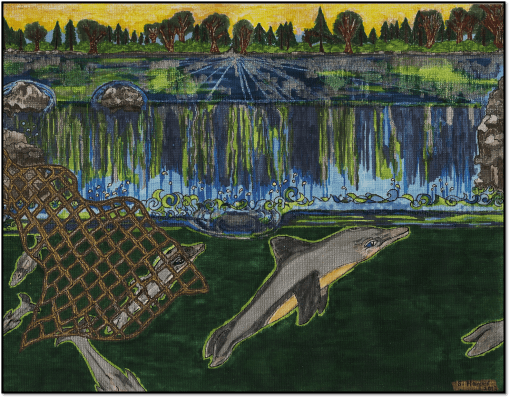
Dolphin Bodies

Dolphin Bodies

Mindful of my sandy feet skimming the sea-foam

I still try tiptoeing

the silvery flicker that parts the waters        because

unlike Christ’s canonized stroll upon the waves

my miracle

of wresting words loose from language

& setting their dolphin bodies forth

to swim into their unbound meanings

slides past

ensconced in a halo of mist

along with everything

every     last     pearlescent thing

that was lost to us

when we were emptied

& jettisoned into the sea

Convection

This thought experiment was inspired by the (impressively copious) weather satellite video loops of convection clouds popping into existence, which my son has been tracking down online and sharing with me… just another example of the uncountable, humbling insights into the natural world that I’m sure would have failed to blip on my radar, if not for his beautiful influence.

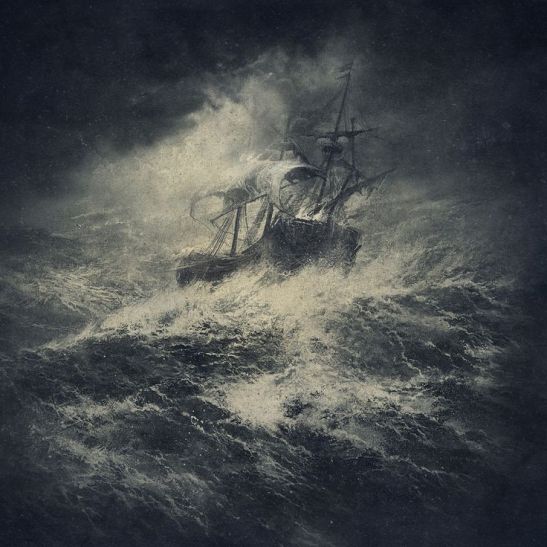
Stormy Sea

Yaroslav Gerzhedovich’s Stormy Sea, courtesy of Google Images

/kənˈvekSH(ə)n/ noun: the movement caused within a fluid by the tendency of hotter and therefore less dense material to rise, and colder, denser material to sink under the influence of gravity, which consequently results in transfer of heat.”

“In the beginning, when God created the universe, the earth was formless and desolate. The raging ocean that covered everything was engulfed in total darkness, and the Spirit of God was moving over the water. Then God commanded, ‘Let there be light’ (…)” Genesis 1:1-3

If     before the beginning
something had not yet appeared from
nothing
how did
nothing
manage     without lungs no less
to take in that convection of a god’s breath
that marked the beginning of creation
(particularly since before there was something
there surely wouldn’t have been things
such as gods or breathing)?

For that matter     out of what non-thing
was said sudden cloud burped
into the foggy     slate gray chaos
that hung     but didn’t
in a sky that couldn’t have been there     but was
ostensibly sandwiched tidily between
the turbulent     blue water
(we’ll address that later)
& the gauzier     brighter     frothier ether
that was not yet the air for the deities
who were not yet themselves?

& if     in the beginning
(as the story goes)
those twin neonates
formlessness & desolation
comprised everything
(however antithetical to actual substance)
that was spontaneously no longer
nothing

from where     for the love of sanity     did that ocean arise?

& why (never mind how)     pray tell     was it raging?

Of the untold passions
we might’ve presumed preceded
all extant matter & manner of cognizance
why did we resort to imagining rage?

Do we unknowingly float
upon the ocean’s foamy resentment
at the resonant indignity of not yet
being not
nothing
but still getting scapegoated for concealing
the primordially shapeless absences of
nothing
with its own nothingness
(unjustly condemned for the volition & malice
that nonbeing precluded it from possessing)
even as it     itself     was entirely concealed
in the total darkness we all know is really
just another way of saying a whole lot of
nothing?

To wit     aside from being a bit fishy
the story does lend itself rather poorly
to proper revelation
amounting     no doubt
to the non-existent body of water in question
being (or more precisely not-being)
rightfully fraught
that antiquity could do no better
than to liken it in myth—
in its purported (not to mention impossible)
shared subsistence with
nothing
before the beginning began—
to Phorcys     the weedy-bearded
progenitor of the gorgons…

Is it any wonder the artists should depict
this mystic transference of hot air
as the wisp of a ship
dissolving into the mist?

STEPHANIE L. HARPER


Brave

towering pine

Some things leave no room for misunderstanding,
like your climbs to the tops of towering pines,
and your belief that you can never cry.

At age five, you dream of a woman
with wings like a bat dressed all in black.
She swoops down, grabs you, pins you in her lap,
and while hitting you over and over, she’s whispering
that it will end when you stop struggling;
so you pretend to relax until her grip loosens
and then you fight to escape, but each time
her strength overwhelms you. It takes
several beatings before you realize
she is trying to help you, she is teaching you
how to be brave—
how to be so still
that you can let yourself have no feeling
when the scratchy hands are pressing into you,
like the night lets itself be swallowed by darkness.

An eight-year-old now, you’re standing
outside their locked bedroom door, waiting
for your mother to call to you
as he yells his nonsense, rips out drawers,
and slams the walls with his fists.
When something made of glass shatters
against the vanity, her cry of surprise
convinces you to call the police.
They come and go in a flash—
barely pausing to ruffle your hair
and chuckle
that it was all “just a misunderstanding”—
and they leave you there,
to keep being unseen.

For most of the school year,
at age eleven, you are chronically ill:
the oozing, itching, grey-swollen chickenpox lesions
that make you potently untouchable,
lead to an infiltration of fevers, flooded lungs,
and swollen, piercing tonsils and ears
that hold you prisoner from the inside,
but soon you come to know your captors
as the oddly loyal, untiring allies
who keep you warded at night, for months.
Your classmates are jealous, though,
that you still make passing grades
in your constant absence from school—
on the phone, they accuse you of faking,
and you can’t help the feeling, either,
that being sick really is a kind of cheating,
like getting something you want
without doing anything to earn it.

Mom is taking you to open a bank account
with your own passbook, though you’re just twelve
(her eyes are still swollen from crying yesterday),
so you can sign for the money you’ll need to get
yourself and your little brother to the airport
to fly to an uncle you barely know in New York,
if she either goes missing, or you find her dead,
because, as she’s confided to you—
and you have no reason not to believe it—
your father vowed to kill her.
For the next three years, then (she doesn’t know),
you skip lunch at school and save the money
to deposit into the “plane ticket” account.
No, she never gets murdered,
maybe even because you always keep watch,
like the kind of parent you’d want to be would,
even after your father finally moves out
during the same summer you get your tonsils
(and the disease they harbored) removed.

You’re now proving to be a picture of health
(though you bear the hunger of indignity, standing
in lines in the school gym for government hand-outs
of peanut butter, processed cheese and expired bread),
because you can run like no one else.
You are your soccer coach’s favorite, you believe,
because you are tough, and you work the hardest.
He makes a fuss over you like you are special,
takes you out for ice cream, has you come along
on fishing trips with his sons, and invites
you over for dinner, or to stay the night,
and you never consider he’ll expect you to repay him
for these casual, kind gestures, until
he’s suddenly always touching and hugging you
as if it is his right, and even though you make sure
only to be in public places with him,
in plain sight of your teammates’ parents,
you can’t discourage his lewd hovering,
or his propositions (which he thinks are charming)
for you to fuck him in the back of his van.
Somebody should be watching!
People are watching, but they only see
the things that have no need
for invisibility, like the crude posturing
of a man just being a man—

just someone who reserves
the Scouts’ clubhouse through Parks and Rec
for a “team meeting” that you feel obligated to attend;
someone who waits on a weekday evening
in a prefab aluminum building
with the lights dimmed
for a fifteen-year-old girl to enter alone,
while, at home, his own kids watch T.V.,
and his wife keeps his dinner warm.

Some things leave no room for misunderstanding—

like the lust throbbing in a man’s neck,
the presumption gleaming in his eyes,
and the fact that wrongs always pile upon wrongs
in the same way he now heaps this assault from behind,
with his thick hands fumbling for your breasts,
on top of his preposterous lie;

and so when he leans in with his belly
and his cock stiffens against the small of your back,
a scream gets trapped in your throat,
and you find yourself struggling wildly—
you elbow him hard in the ribs,
then rear up and ram your head into his chin,
and somehow stun him long enough
to get away—

you get away,
but leaving yourself there
unseen in the dark
doesn’t ever feel brave.

STEPHANIE L. HARPER
Everest

Everest

“…since you disregard all my advice
and do not accept my rebuke,
 I in turn will laugh when disaster strikes you;
I will mock when calamity (…)

overtakes you like a storm…”             Proverbs 1:25-27

Icefalls—
freezing streams of tears
formed in the weather of her own invention—

rip a hidden dominion
of chasms
beneath

this Mecca we faithfully revisit
upon surviving each prior pilgrimage
& restless penance at base camp.

No snow-blind bid for ascension
will leave its trace upon this cruel, white slate,
as cold-pierced flesh, violated senseless, chases

the gossamer promise of substantiation
in the biting night silence,
scaling massive vertical icy rises that crest

on the barren horizon, as intimate as distant;
in this alien nest we recognize
lies the black womb’s waif—

the silky red dawn
drawing its first cerulean-cradled breath—
heralding the bloody miracle of life & death.

So tiny are these pitons & ropes
we follow toward willful, brutal injury—
they mark the fabled way through

this bone-strewn wilderness
to the sun-frozen summit,
her brimming lids blinking in feigned oblivion,

now hiding her sinister eyes,
now revealing
contrived glimpses of rapture.

STEPHANIE L. HARPER


Unvoiced

Unvoiced

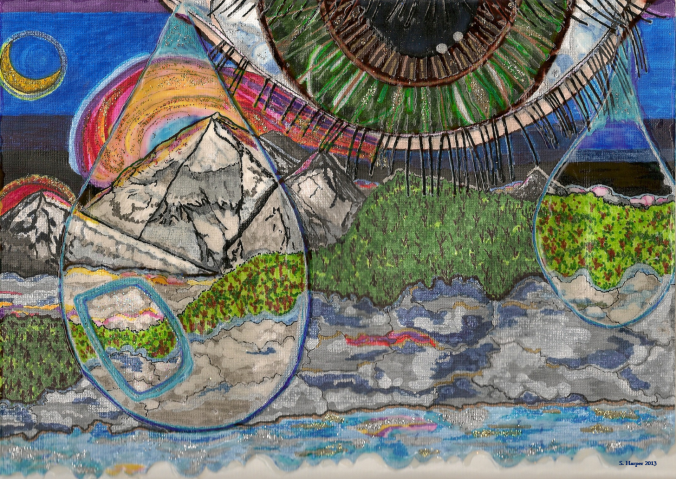
Illustration by S. L. Harper

The words from the dream are
wisps in the air like broken
spider webs wrapping invisibly
about my face and forearms

The fake sunrise tarp draped before me
ripples like a summer mirage
half-soaked into the rural street

and then          as if I were not supposed to
I step through and place my foot
solidly into an evening of dark specters
waiting outside of their existence
to become what I am

there

I am the cool turpentine
wash of grays seeping over
a dusting of brown sand in the road

I am the night falling upon
neglected pastures of weeds
sputtering up about the silhouettes
of tree stumps and old swing sets

I am the street lamps’ sallow illumine
peering out sensibly from between
foolish tree skeleton embraces

and I am still the child
twisting acorns into the asphalt
with the soles of her shoes

squealing gleefully into the night

STEPHANIE L. HARPER

“Unvoiced” made its first appearance in Sixfold magazine, winter 2013 edition.

I was inspired to include it on my site today after reading a little metaphysical beauty posted on Robert Okaji’s  O at the Edges , called “Irretrievable.” 

Anniversary #18

Mike and I celebrated our 18th anniversary on January 23, 2016, but I thought this poem would make a great post for Valentine’s Day… The photo I’ve chosen to accompany my poem is of a bird I’m particularly in love with — he is a Cob named Bryn, and he is the devoted mate to a Pen, Wynn. They are a glorious pair whose annual brooding and chick rearing on the moat of Bishop’s Castle in Wells are meticulously covered by brilliant photographer, Will Glenn. In this shot, Bryn’s industrious foraging in support of his mate and their progeny is not only noble and adorable, but it reminds me of Mike’s constant efforts to be a nurturing, responsible husband and father, and ever-evolving human being, who inspires me in more ways than I could ever express!

To all you lovebirds out there:

HAPPY VALENTINE’S DAY!

bryn_s_bottom_by_earthhart-d8efjc7

Photo by Will Glenn: EarthHart.deviantart.com

An engineer has just so much to say
With breath, enthusiasm, eye-contact—
And words seldom emerge in shades of gray,
But it’s your love that keeps my heart intact.

You’ve seen me at my worst and never balked,
You’ve seen me giving birth, begging for drugs,
Stood by when even I could not have talked,
And let me hide while you’ve dispatched gross bugs.

Your actions are a testament to Love
That has no need of meter, trope, or rhyme—
Lip-service, poets know, is not enough
To build a life that stands the test of time.

For eighteen years (and more!) I’ve loved you—that’s no bull!
I know I’m blessed to have a heart that feels so full!

STEPHANIE L. HARPER